“If Lake Powell Was a Ranch:” WLA’s Field Day at Mountain Island Ranch
MOUNTAIN ISLAND RANCH, Colo. — After no snow and unseasonably warm temperatures this winter, the effects of drought could be seen everywhere at Mountain Island Ranch. But clever construction and significant conservation investment from federal and private sources shone through, demonstrating landowner innovation and fortitude.
Kenyon Fields and Mary Conover have done remarkable work in the face of “aridification,” the transformation into a permanently drier climate. Decades of drought have swept across this incredible ranch located on the Colorado- Utah border near Grand Junction. Drought has dried streams, reduced irrigation water supplies, and necessitated changes in ranching techniques. This year might be the worst yet.
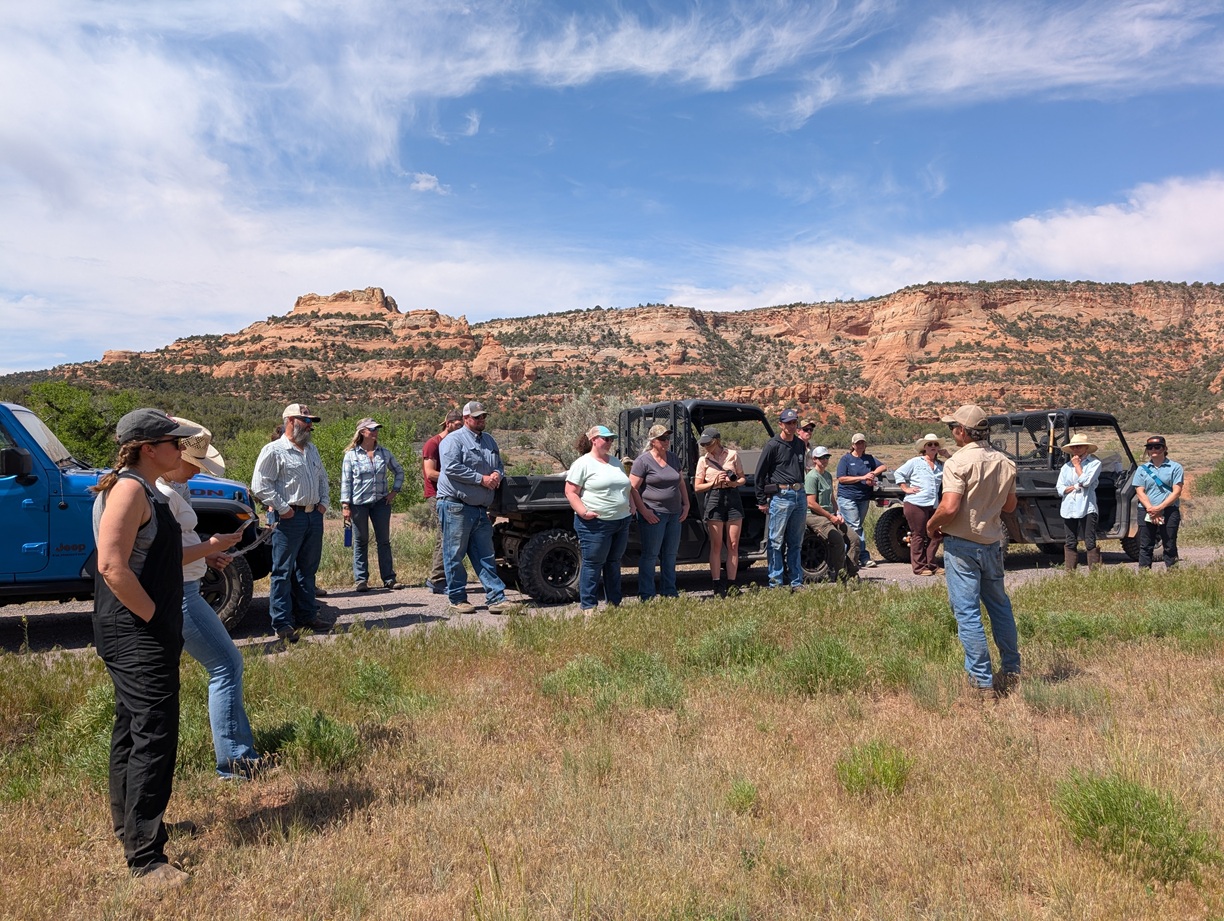
On May 13, Western Landowners Alliance and a score of attendees toured Mountain Island Ranch (MIR), seeing firsthand the efforts Fields and Conover have put into slowing water on the land, mitigating invasive species, and thinking about how they can build resilience on their property to allow it to thrive for generations down the line. The tour, funded by the Walton Family Foundation, was a great opportunity for ranchers and producers to get on-the-ground experience observing various water conservation techniques: what worked, what didn’t, and what helped in unexpected ways.
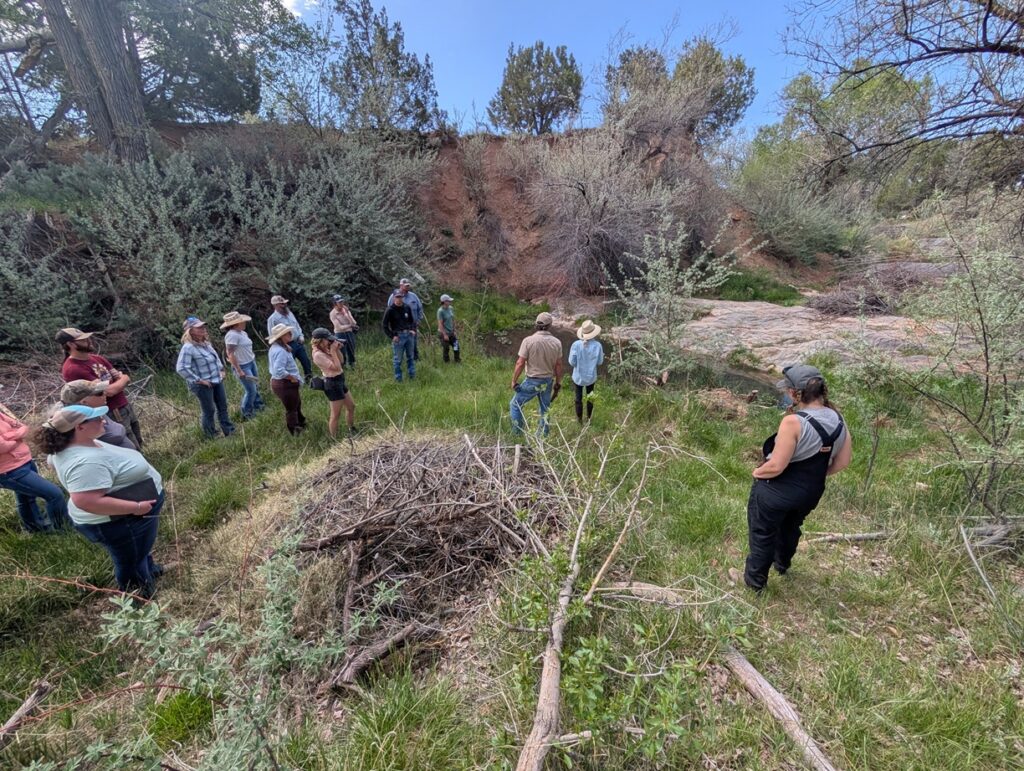
We started the day with an explanation of how MIR came to be. Conover’s family has stewarded this property for over 60 years, with both the borders and operations changing over the decades to adapt to the changing climatic conditions. Conover’s family has been instrumental in conservation in this neck of the woods, as her mother helped found the Colorado West Land Trust, which has now conserved nearly 150,000 acres in western Colorado. Climate change and the ever-shifting economics of ranching caused the family to experiment with the operation, trying everything from running cows and calves, bison, and sheep before eventually liquidating part of their high-country land and cattle herd. Now, the ranch custom grazes for other ranchers in the area when conditions allow, but drought and climate change continue to challenge the family operation even with this economic model.
The property, outside Glade Park, Colorado, shares a plateau with Colorado National Monument. Big red rock canyons and sweeping vistas, along with productive valley bottoms and stands of cottonwoods, make up much of the ranch. Over the past decades, invasive tamarisk and Russian olives claimed large parcels of the Little Dolores River’s floodplain, but with significant application of labor and long-term planning for planting native species, Fields and Conover have made enormous inroads reclaiming the river bottom.
This work aims to keep water on the landscape. With longer, hotter summers and less precipitation falling during the winter, making the most of every drop is the only way for ranching operations to survive. By investing in post-assisted log structures, long-term conservation planning, and, importantly, relationships with the Bureau of Land Management and other government entities, Fields and Conover have leveraged grant funding and labor to do an incredible amount of work on behalf of endangered Gunnison sage grouse, native plant and tree species, and the elk, deer and other wildlife across their ranch. Conover, Fields and family, together with the BLM and Colorado Conservation Corps crews, have built over 200 beaver dam analogs (BDAs) and post assisted log structures (PALS) in the past decade to try to keep the stream flowing for more of the year.
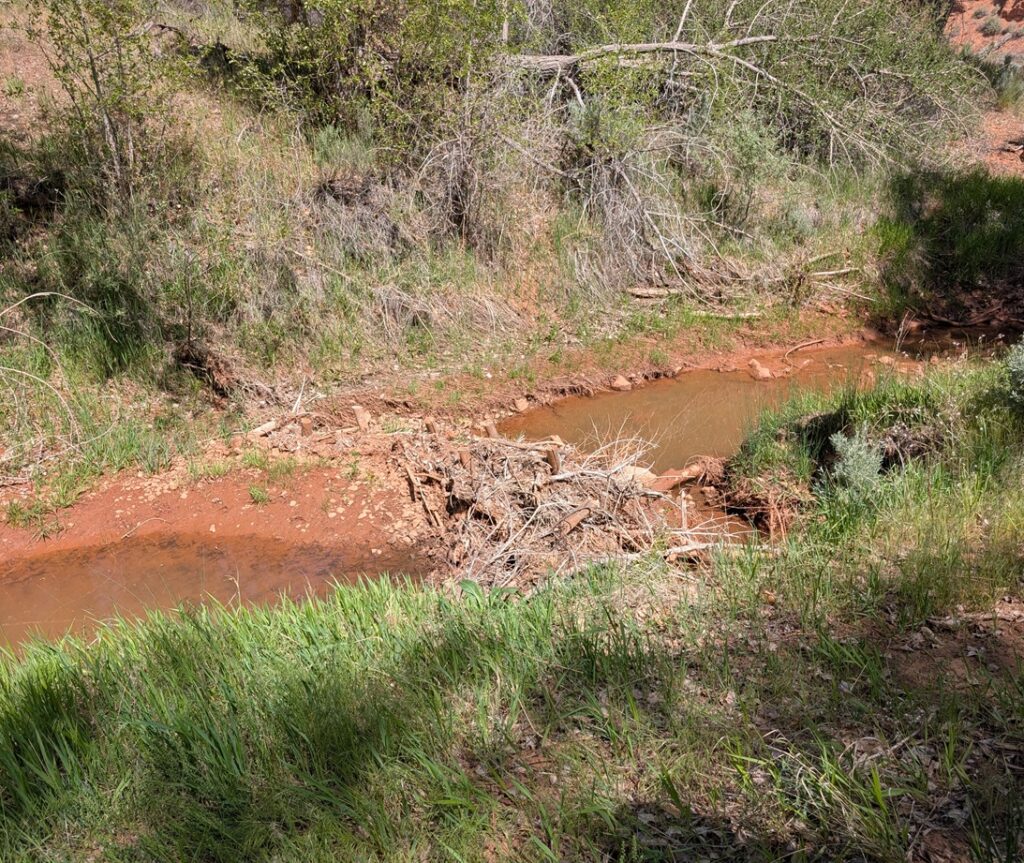
During the tour, Fields explained the value of PALS in creating meanders in the streambed, slowing water down, and creating pooling effects behind the structures. We also saw remarkable evidence of this strategy’s success. Behind one of the PALS near the ranch headquarters, a beaver had built a new dam. Attracting nature’s engineers to the Little Dolores is hugely important, as research from Utah State University has shown that the mega rodents make all the work in building PALS or BDAs economical in the long run, as they will do the expensive maintenance on the stream themselves.
PALS are not intended to be long-term fixes but are just the first step in restoring degraded stream channels. Floods wash out some of the structures over time while building up sediment behind them. The debris that washes out often adds structure further down the river’s course, and the trapped sediment raises the stream bed, reconnecting it to the floodplain and, in turn, storing more water. While it might seem strange that all this work eventually flows down the river, that “failure” is just part of the long-term strategy for water conservation on the ranch.
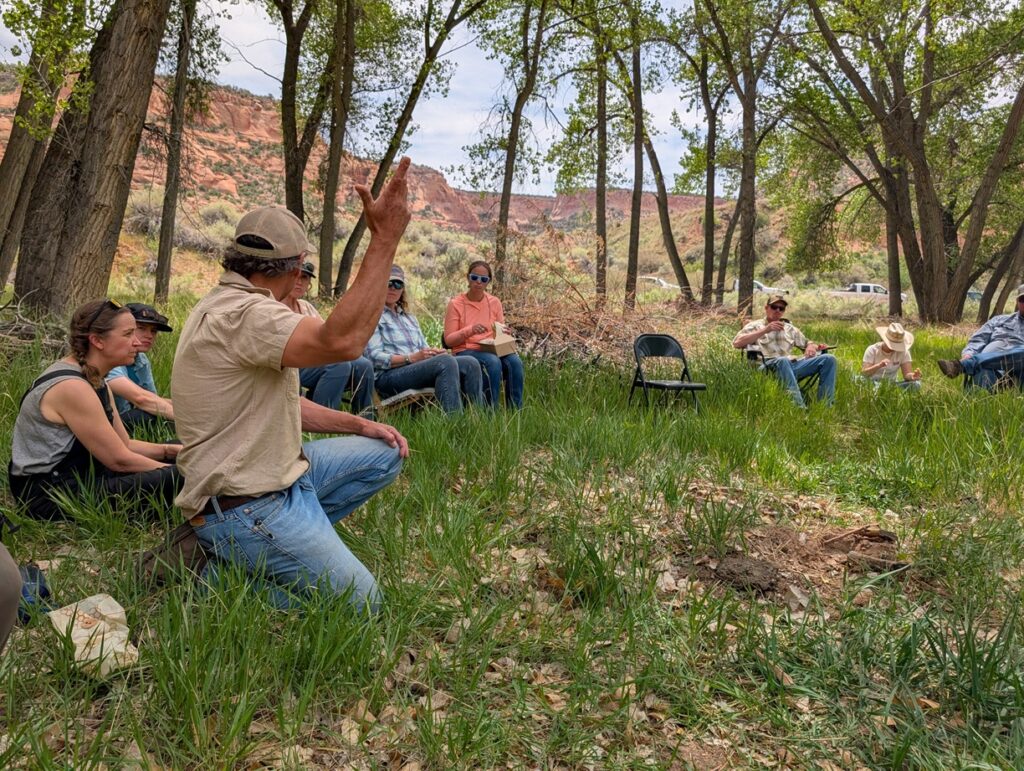
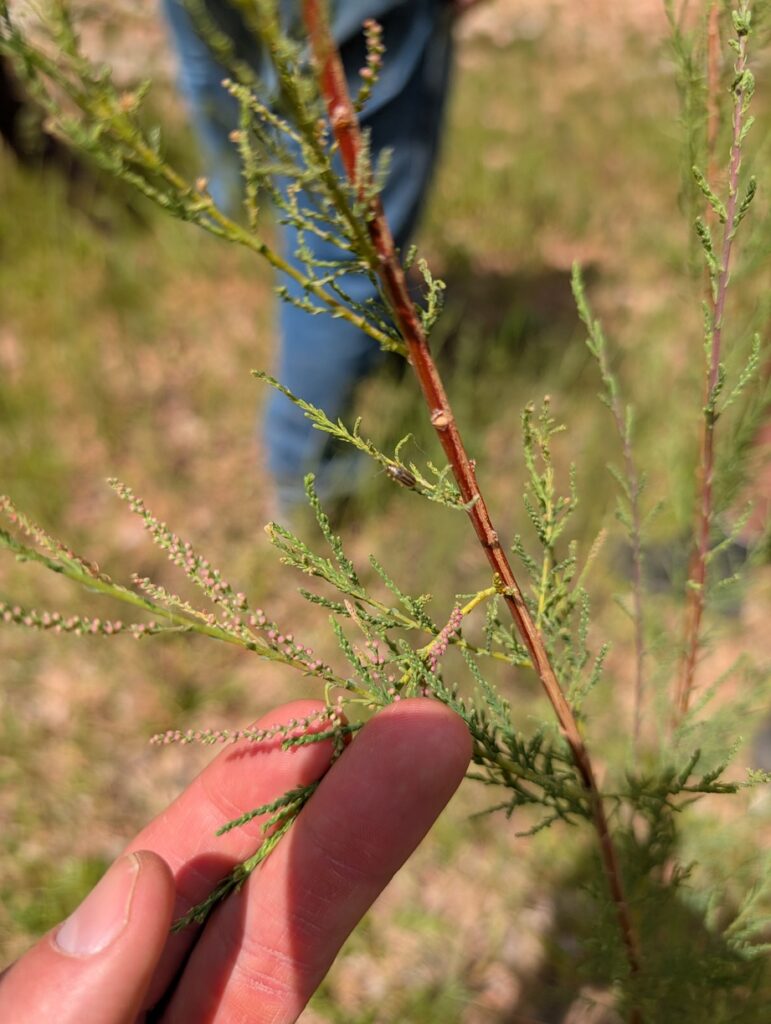
Fields was also able to walk the tour group through the Russian olive and tamarisk mitigation they had done. These invasive species are all “straws,” as Fields put it, and it takes a lot of labor to clear them from the river bottoms. And they chose not to remove all of these trees, as they do offer ecosystem services to wildlife. But with hand crews and judicious application of herbicide, Russian olives can be managed to support the ecosystem without outcompeting other native species. We also got to see one of the most effective biocontrols introduced in the Colorado River Basin in action. Tamarisks were growing in the Little Dolores’s bed at our second-to-last stop, near the cabin where ranch employees live. On those young trees were quite a few tamarisk beetles that Fields and Conover had released on their property, the little destroyers that have had a phenomenal impact on the invasive trees.
Fields and Conover also shared some conservation projects that have not worked out as hoped. On one hay field, Fields described the work they had done with Colorado Parks & Wildlife to test a new seeding technique. “Pothole discing” uses a special tool to basically dig little potholes over a field to save more water and make it easier for grasses to grow. It didn’t work. But it did generate lessons for Fields, Conover, and field tour guests, about what makes techniques successful for re-establishing native grasses in former hayfields, and where the technique has seen success (primarily in soils with more clay to hold water).
At the end of the day (after a half dozen stops and lunch), a smattering of rain fell on the western end of the ranch, where the tour had stopped amidst the skeletons of piñon and juniper trees that had burned in a fire just last year. Fire has become an annual event on this ranch, and mitigation and preparation are always considered. Where there is water, there is life, and the work Fields and Conover have done on Mountain Island Ranch has been aimed at making sure life continues on the land they love and care for far into the future.