How beavers and acequieros can work together
MORA COUNTY, NM – In a landscape where burn scars deliver flash floods and drought impedes production capacity, water is a primary concern for many northern New Mexican landowners. Those who irrigate crops and fields are likely parciantes in their local acequia networks, community-operated irrigation systems that deliver snowmelt and rainwater through a series of historic, complex channels. In the face of drought, diminishing snowpack, and infrastructure damaged by fire, what does it mean when beaver arrive?
On June 26, landowners in Mora County gathered to discuss the challenges and opportunities of living with beavers on working lands. The collaborative event, hosted by Alianza Agri-Cultura de Taos, Amigos Bravos, and New Mexico State University, provided local landowners with an insightful presentation led by New Mexico State Taos County Agriculture Extension Agent, Will Jaremko-Wright, and Amigos Bravos’ Restoration Specialist, Elliot Hendry. Both Jaremko-Wright and Hendry shared their knowledge of hydrology and beaver management, which began place-based, solutions-oriented conversations throughout the room. Beavers and acequias can co-exist, but there are essential insights and strategies needed to make the relationship work.
The challenges and opportunities beavers bring to acequia systems
As within any irrigation system, beavers can pose a threat to acequias’ flow and structure. Acequias require shared community responsibility. If a beaver conflict impacts downstream parciantes, the mayordomos, the elected managers of an acequia, bear the responsibility to keep the water flowing. Those who have removed beaver dams can testify to their persistent nature and hardy build quality, requiring significant time and labor.
Another primary concern for many farmers and ranchers is flooding. Beaver ponds can flood the surrounding areas, which can impede grazing, overflow headgates, and damage infrastructure. Each of these outcomes can contribute to financial loss.
Despite the challenges of coexistence, beavers can be highly beneficial to working lands. In northern New Mexico, many acequias have become deeply incised due to post-fire flooding. One landowner shared that a previously two-foot-deep channel on her property has deepened to 15 feet since the Hermits Peak/Calf Canyon Fire four years ago. She wanted to know how to encourage beavers to return to her land.
Incision, the cutting of channels deeper into the land, limits or removes acequias’ contact with flood plains, which makes it harder for them to deliver water. Beaver dams combat this process by slowing the speed of moving water and allowing sediment to accumulate upstream, raising the streambed over time. These functions cannot just restore a single ditch, but create and broaden valleys if maintained.
Water retention is another benefit of beaver dams. Because acequias transport snowmelt, the system is vulnerable to unseasonable heat waves that release water before scheduled irrigation times. As Jaremko-Wright pointed out, acequias do not have storage reservoirs to retain water that flows before landowners are ready. Beaver dams allow for natural surface water storage that increases the amount of time water is on the land and, subsequently, increases groundwater recharge. Hendry highlighted that beaver dams do not reduce the volume of water transported, but prolong the time at which it is released, which makes all the difference in years like this one where peak snowmelt occurred in April.
Tips and tricks for managing beavers on working lands
How can someone reap the benefits of beaver presence while navigating the challenges? Is it possible for acequieros to host beaver on their land? Elliot Hendry from Amigos Bravos shared the beaver-conflict mitigation strategies the organization has used across New Mexico.
To restore flow
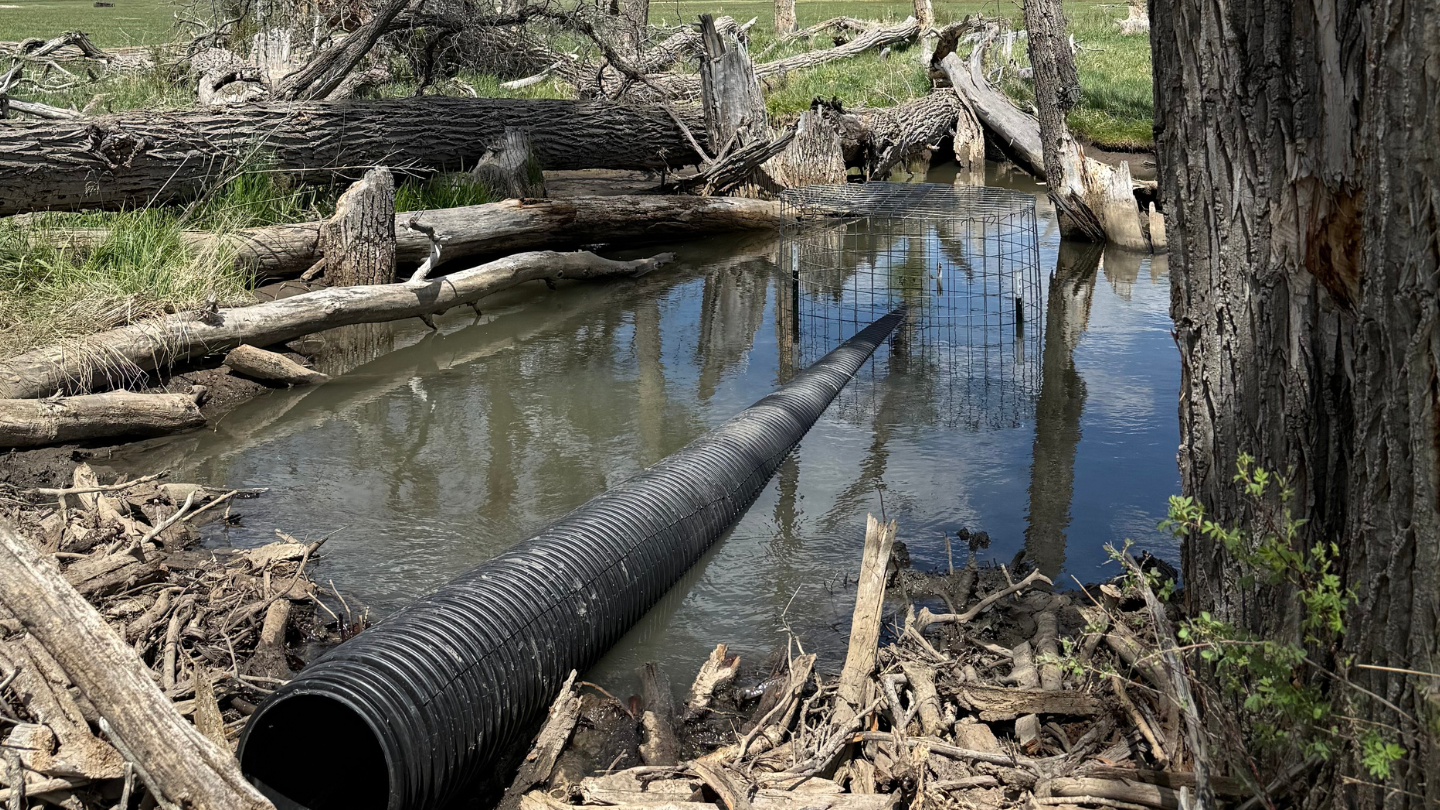
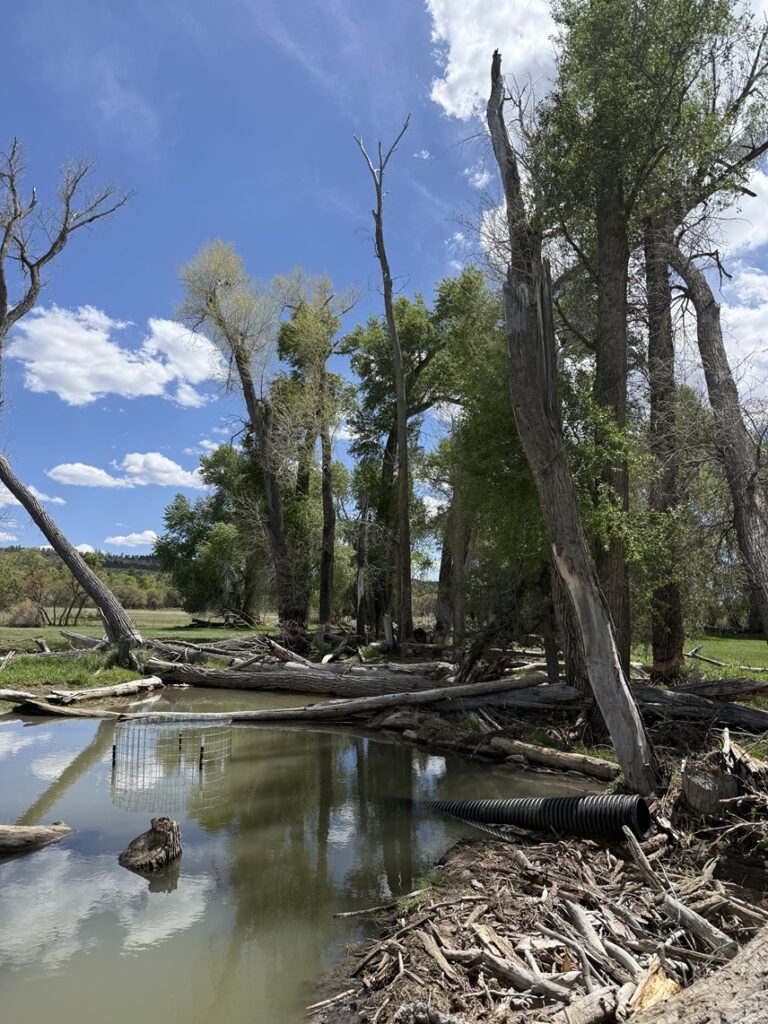
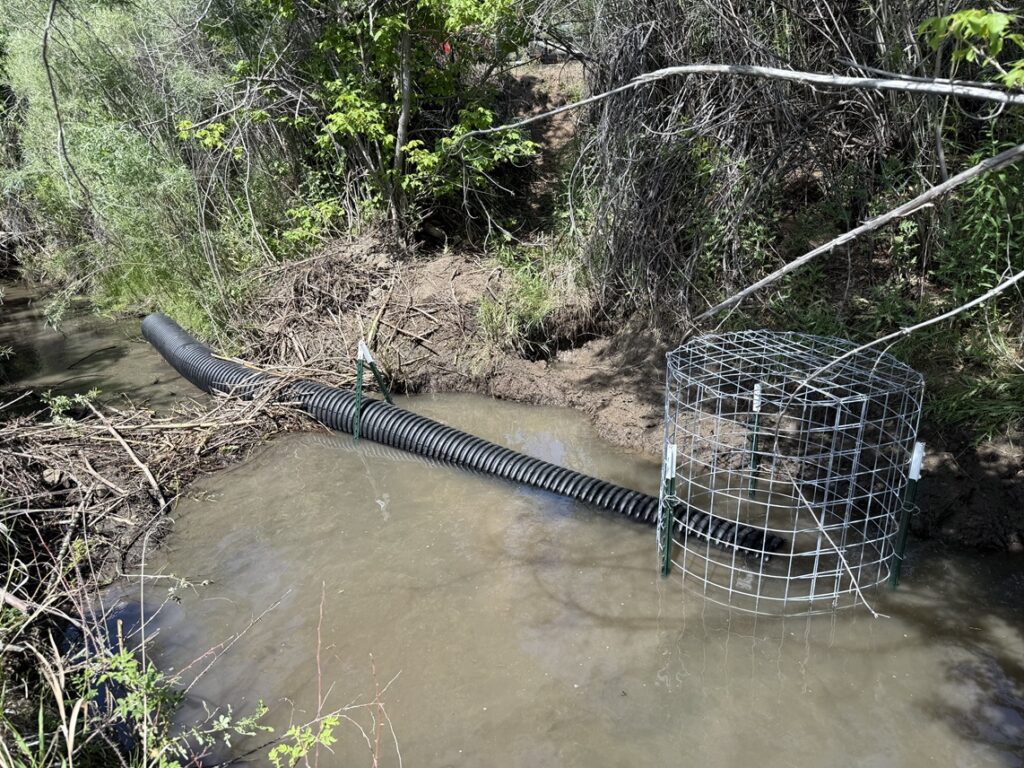
The “Beaver Deceiver” or pond leveler. A HDPE pipe, typically between 8 and 22-inches in diameter, is submerged in the water upstream of the dam and directed to bypass the dam by 2-10 feet downstream. Various holes along the sidewall of the pipe allow for air to escape while water is diverted past the dam, with stakes and cinder blocks used to secure the position of the pipe. At the inflow, the pipe is protected by a circular cage made of galvanized livestock fence to prevent beaver interference.
To protect culverts and piping
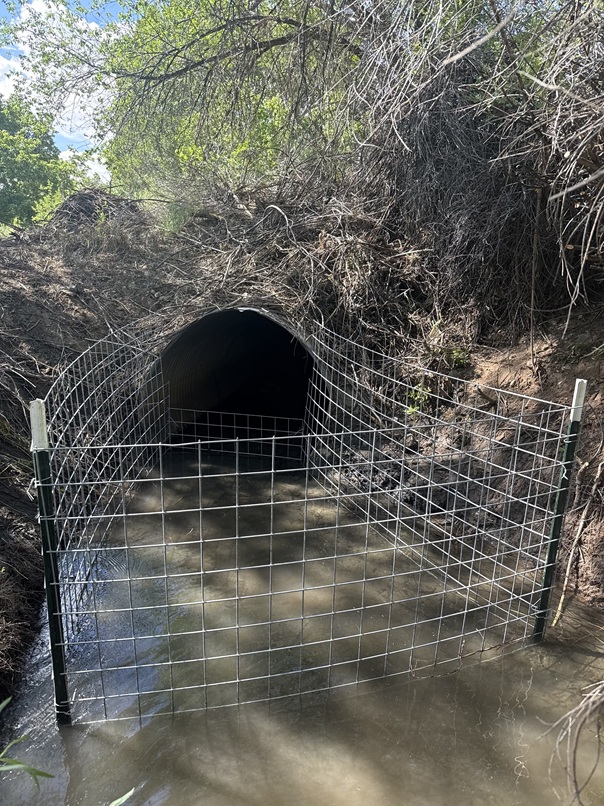
Trapezoidal fencing is a fencing structure with 3 or more angled sides which disrupts a dam’s ability to take shape and disincentivizes beaver interference. This fencing can be built with the materials at hand; cattle panels and t-posts were said to be notably effective and secure. Typically, it is only necessary to fence the inflow of the culvert (all the way to the bottom of the inflow), but those dealing with especially determined beavers may need to fence both entry points.
To protect trees
Chewing deterrents. In the case of vulnerable saplings, fencing them off completely with cattle panels or woven wire is a reliable way to ensure their survival. A local landowner suggested creating a buffer zone between the fencing and sapling that is greater than 2 feet to lessen future maintenance as the tree grows. For more robust, adult trees, a mixture of sand and latex can be painted onto the base of the trunks. The latex acts as an adhesive agent for the sand, which deters chewing behavior.
To attract beavers
For those seeking beaver ingenuity, creating habitat is a helpful way to encourage their presence. Planting native willow species along waterways and installing Beaver Dam Analogs (BDAs) can help slow fast-moving water so that beaver can more easily create dams, thereby improving floodplain connectivity and expanding riparian habitat. A local landowner shared his experience partnering with beavers to restore a previously barren parcel of land. His project began with planting over 2,000 trees in one year. The next year, beavers arrived. As the years went on, he navigated the “learning curve” of working with beavers. After a flood event in 2022 displaced the beaver colonies, he installed BDAs to bring the beavers back. New BDAs did the trick, and he was happy to share that beavers had returned to his land.
The nuances of the beaver renaissance
It is clear that the conversation in northern New Mexico around beavers is shifting, as it is across the West. Erik Kalsta, a rancher in Montana’s Big Hole Valley and WLA’s Working Wild Challenge program director, shared that beavers appear to be experiencing a “renaissance.”
In light of their growing popularity, Erik highlighted the importance of acknowledging the impacts and tradeoffs involved. On his own ranch, Erik has been faced with dangerous fallout from beaver work, such as a beaver-built dam blocking a 60-foot culvert beneath train tracks. These issues tend to be expensive ones, like when beavers caused $40,000 in damages to a collaborative watershed improvement project. In one case Erik was able to mitigate the problem with excluders, however; in the other he is still trying to develop an effective solution.
“Within the Working Wild Challenge’s 4C’s framework, compensation and appropriate control measures are necessary when it comes to beavers,” Erik said.
As more beaver relocation projects go underway across the West, it is imperative that landowners are provided the resources necessary to address the challenges of stewarding beavers on working lands so the benefits can outweigh the costs.