Wyoming looks for rancher, farmer feedback on new Voluntary Conservation Program
As drought continues to strain water supplies across the Colorado River Basin, Wyoming is creating a new voluntary program that could allow irrigators to conserve water without risking their water rights. In the 2026 legislative session, Wyoming elected officials passed a new act establishing a Voluntary Water Conservation program in the state for the first time. This June, the Wyoming State Engineer’s Office went on a tour of agricultural areas in the state to hold listening sessions with water users in the hopes of tailoring the program to its best possible use.
Western Landowners Alliance has long supported voluntary, incentive-based conservation approaches that help landowners avoid mandatory restrictions while maintaining working lands. With prolonged drought placing increasing pressure on the Colorado River Basin, mandatory curtailment is stalking irrigation ditches and pivots right now.
To combat that threat, states across the West have launched pilot programs and passed laws like Wyoming’s Voluntary Water Conservation Program Act to get ahead of the curtailment curve. State Engineer Gebhart recognizes that this is just a single tool in the toolbox of water conservation, something he told the Lyman, WY crowd during his presentation on June 18.
“We are looking for tools to deal with limited water in the system,” he said. “Voluntary conservation is a tool.”
The emphasis on “voluntary” matters quite a bit. Ranchers, farmers, and producers who rely on irrigation water to grow crops, water livestock, and steward their land are taking a risk when they choose to forgo their allotment of water. Making the choice to conserve water is a difficult one, and Wyoming’s new program recognizes that issue.
How the program works
At this point in the process, the state engineer is gathering feedback to make the program as easy to use as possible. Landowners applying for the program will use a form that looks like the familiar standard forms already used by the State Engineer’s Office, and doubly so for landowners who participated in the System Conservation Pilot Program that ran from 2015-2018 and in 2023-2024 in Upper Colorado River Basin states. Beyond basic information (name, contact information, documentation of land ownership, water permit number, source of supply, etc.), applicants will need to:
- Describe their planned project and how it will conserve water
- Explain how this water is normally used (days diverted, irrigated acres, how much water is diverted)
- Where the project is and if it is in an irrigation, conservancy, or watershed improvement district.
The Act is also clear in its requirement to let adjacent landowners and neighbors know about a conservation plan when applying for the program. At this point, the Act establishes the legal framework for the program but does not appropriate funding. Participants may become eligible for future funding sources as they become available. The Upper Basin (Utah, Colorado, Wyoming, New Mexico) has requested federal funding to pay for voluntary water conservation projects like those under Wyoming’s new law, but currently no funding is available. However, the state engineer anticipates some federal funding might be available for projects in 2027.
Applications will be evaluated to determine whether the project conserves measurable “wet water”, protects other water users from injury, complies with Wyoming law, and serves the public interest. Applications must also demonstrate that the water has been put to beneficial use in at least three of the previous five years.
Measuring the saved water is also an important part of the puzzle. For agricultural projects, the state of Wyoming uses eeMETRIC, a method that uses satellite data and weather information to measure evapotranspiration. For cities, towns, and other non-agricultural uses, the state will use other measurement methods to determine what is being conserved.
Beyond all of this, landowners will not lose their water rights when participating in the Voluntary Water Conservation Program. Water conserved under this project will be protected from abandonment claims, and under Wyoming law conserved water is not considered an export, as it is illegal in the state of Wyoming to sell water across state lines.
Time and storage
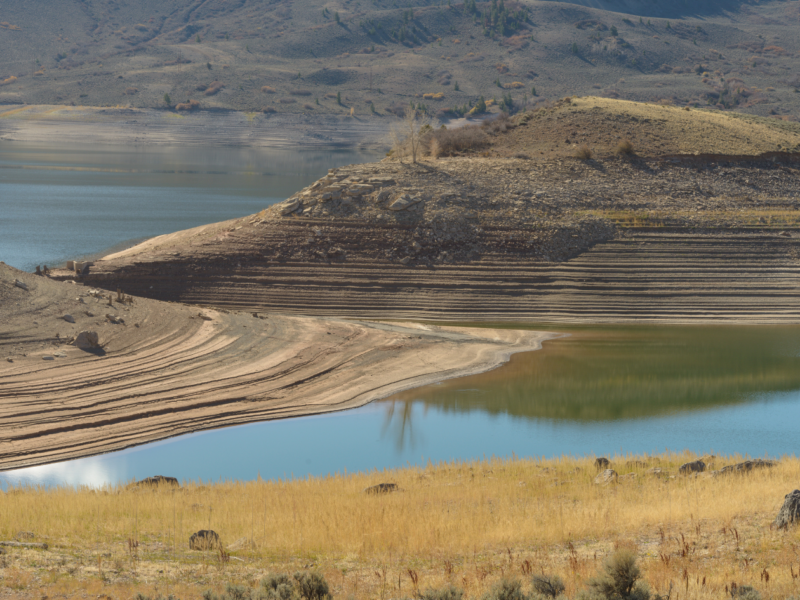
Water cannot be conserved forever. Instead, the conservation program limits these projects to five years, after which the right has to revert to its normal usage for two years. Conserved water has to be stored somewhere to provide downstream benefits; as to where this saved water would go, the only reservoir in Wyoming currently available for this purpose is Fontenelle Reservoir. The state engineer’s office is looking at getting additional capacity at the 345,000 acre-foot reservoir, which sits below 50% of the state’s irrigated lands.
As Wyoming’s cities and towns grow, making sure they have long-term access to water is going to be a vital concern. Avoiding the “drying up” of ranches by municipalities purchasing them for their water rights, as has happened in Colorado is something the state engineer is looking to avoid, and is working on other tools to make municipalities feel secure in their water resources.
Finally, landowners can apply to be notified about projects that could impact them and can comment on applications. If owners of water rights that might be injured, or any others who could be adversely impacted by a project can provide comments prior to approval within 30 days of public notice being posted.
What next?
The State Engineer’s Office will take input from stakeholders and begin drafting the program’s new rules. Once those rules are ready, they will give public notice and begin the review process. During that review, there will be a 45-day comment period for the public to submit comments before the rules are finalized.
If you’re interested in participating, or simply want to shape how the program works, now is the time to stay engaged. The rulemaking process will determine how accessible and effective Wyoming’s first voluntary water conservation program will be for producers across the state. For more information or to get contact information for the Wyoming State Engineer’s Office, head to https://seo.wyo.gov/home/colorado-river-voluntary-water-conservation-program/voluntary-water-conservation-program.