Indigenous Irrigation Looks at the Whole World
There is a basic assumption that undergirds many of the conversations about water in the west: what irrigation is.
Irrigation is commonly thought of as man-made structures moving water from one place to another, providing water to land by artificial means. But what if there was more to it than just diverting water via pipe, ditch, or trench? What if irrigation was expanded to not just fields, but whole landscapes?
Considering the Entire World of Water
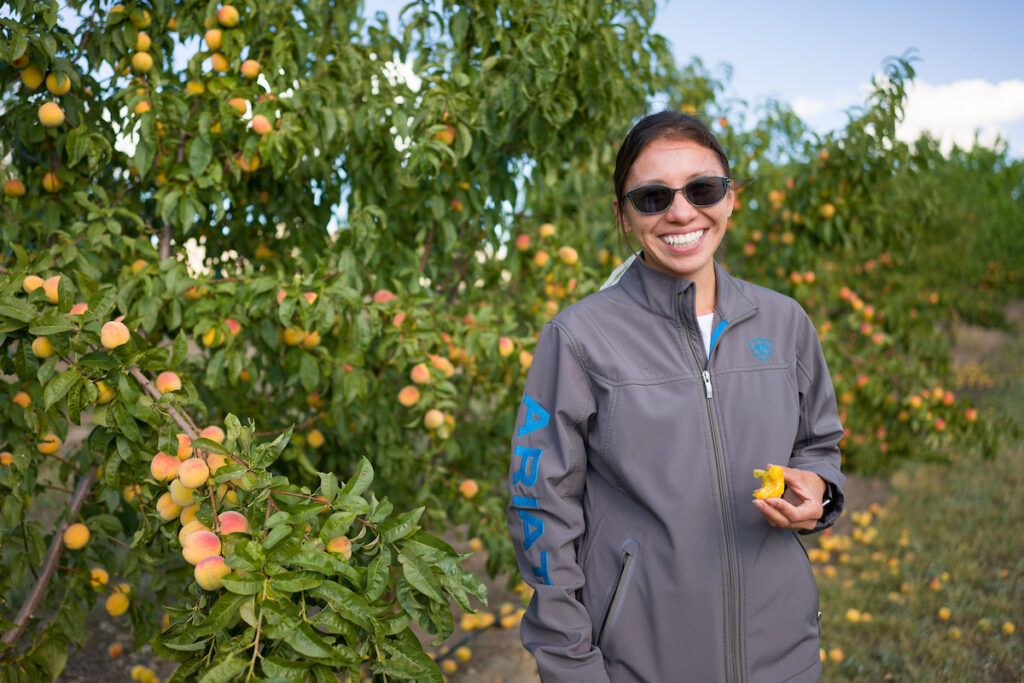
To Reagan Wytsalucy, irrigation should be thought about holistically, expanding its definition beyond merely moving water. A professor and plant scientist at Utah State University Extension and member of the Navajo (Diné) Nation, Wytsalucy is an expert in sustainable agriculture, tribal food systems, and indigenous crops, like the southwest peach and Navajo spinach.
“There are two different ways we can divide out irrigation from tribal communities: there’s manmade assisted irrigation structures that may have helped convey water in certain directions and pathways,” said Wytsalucy, “and then there’s managing the entire landscape so you’re supporting the existing water systems Mother Nature has established itself.”
“And then there’s managing the entire landscape so you’re supporting the existing water systems Mother Nature has established itself.”
– Reagan Wytsalucy
Indigenous communities have managed landscapes to support hydrologic health since time immemorial. Research from the United States Forest Service has shown that indigenous people utilized prescribed fires to create better forage for bison herds. After a fire, the new, sweeter smelling grasses attracted animals, and Native Americans used this tool and their deep understanding of the prairie and grazing animals to shape the landscape in ways that improved ecosystem health and provided more reliable and sustainable food sources, including bison. According to Wytsalucy, agriculture followed a similar pattern.
“Native Americans allowed Mother Nature to flow. They were strategic in allowing where the water flows. If the water access is here, what’s it supporting? Do we divert this into a different area? Use the land space the water is flowing through and manage that?” Wytsalucy said.
Spiritual practice, practical knowledge
For some indigenous people, agriculture is as at least as much a spiritual practice as an economic one. Daryl Vigil, a New Mexican descended from the Zia and Jemez Pueblo peoples who has been working on food and water on tribal lands for 15 years, told On Land that agriculture is a key aspect of how native farmers and peoples connect to and understand their lands.
“Tribal agriculture, I look at it more through the lens of a spiritual practice in modern days than in sustainable things that [tribes] needed to do just to live,” Vigil said. “My lineage, my grandparents, who they are as farmers, my brother who continues to be a farmer … those values are leaving indigenous country because we’re not sustaining them.” This spiritual lens, both Vigil and Wytsalucy emphasized, prompts indigenous farmers to think in different ways as they seek answers to the questions drought asks of agriculture.
Various planting techniques formed over time as tribes sought to grow food in a dry climate as indigenous agriculture made use of water’s regular and irregular appearances on the whole landscape. For instance, “There’s an extremely old practice of planting corn that is partially symbolic and was passed onto me,” relayed Wytsalucy. “You plant corn in bunches, every 10 feet, put corn in a hole, then water those holes. With a corn stalk every 12 inches apart, the corn goes in spirals in those bunches.” These holes and spirals funnel water toward each plant and are also emblematic of the cycles of life and generations of families that tended that place.
“You start clockwise and going in a circle and going outward like spirals on petroglyphs” she said. “Corn is representation of our entire life, it’s part of our ceremonies, it’s sacred. It’s a representation of how we live life.”
Similarly, the Zuni Pueblo people devised a style of agriculture nicknamed “waffle gardens.” By using a clay-rich soil to craft a series of berms that looked like a waffle, Zuni Pueblo farmers captured water during precipitation events and let it slowly sink into the soil where seeds were planted. Locating agriculture strategically, and making the most of every drop of precipitation, was far more efficient than constructing large earthworks to move water long distances. Indigenous farmers planted crops in the shade of canyon walls, near seasonal streambeds and natural springs and seeps, and used flooding from rain events to irrigate their plants.
Lost but not forgotten
The cleverness of indigenous practices was scrubbed away as colonization swept Native peoples off the landscape, and many of the drought-adapted techniques were lost. Vigil sees modern agriculture as a confused network of ideas and economic decisions, but one without an overarching definition or goal.
“We have a situation where 70-80 percent of water use in the Colorado River Basin is under the moniker of agriculture and as we speak today there is no consolidated basin wide, seven state conversation about what agriculture is or isn’t,” Vigil said.
For Vigil, agriculture is an economic strategy that works well in certain areas, but not at all in others. As climate change continues to challenge the status quo, Vigil says bigger changes need to be considered.
“We need to be growing the things that make sense, importing the things that make sense, and really rethinking our economic strategies,” Vigil said.
Indigenous farmers are indeed working hard to save and breed many crop and livestock varieties adapted to the harsh conditions of the drought-stricken Southwest. Wytsalucy said Hopi farmers refuse to irrigate any of their crops, believing that once they do, the heirloom varieties they grow will lose the adaptations that allow them to thrive in their homelands.
“If there’s more water, they will adapt to needing more water. If there’s not, the better off they will be in the time there is a drought,” she remarked. “We know they will survive.”
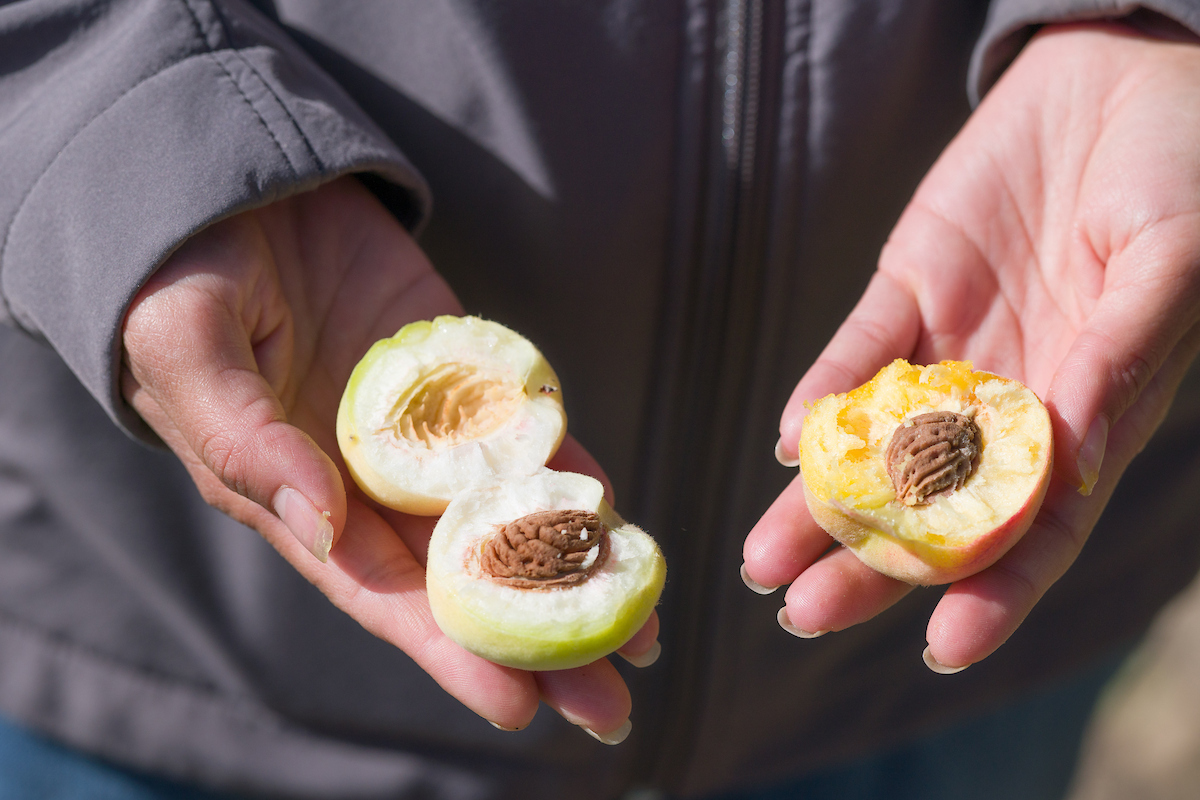
Increasingly, researchers, led by indigenous scholars and farmers like Wytsalucy and Vigil, are recognizing that sustainable agriculture in the Colorado River basin is likely to share strong roots with the indigenous agriculture that was developed in the region over millennia before modern dams and irrigation infrastructure (and the abnormally wet period at the start of the 20th century that was used to size that infrastructure). This is demonstrated in Wytsalucy’s research on the Southwest peach, a small, sweet variety of the stonefruit that was largely destroyed during the era of colonization.
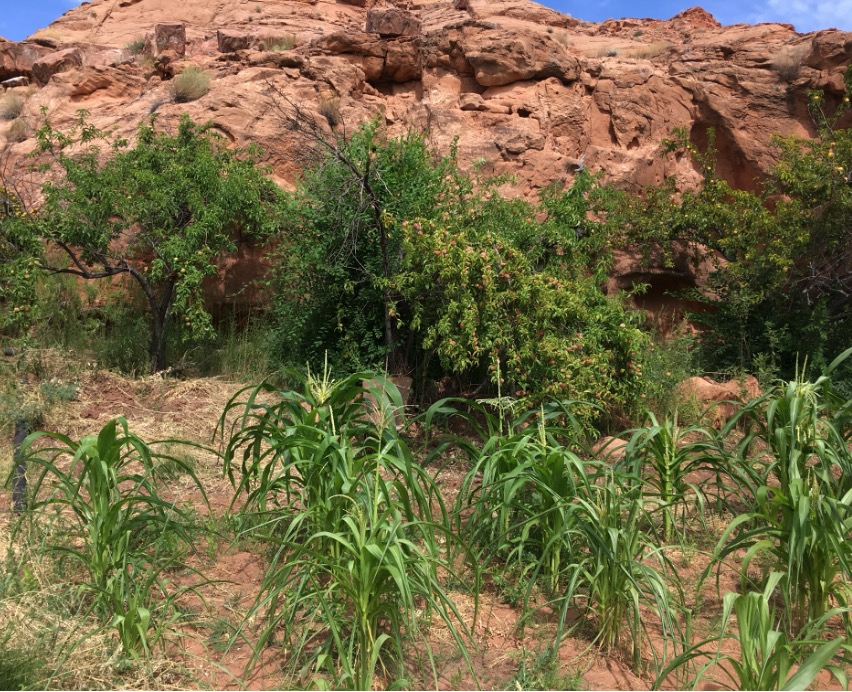
Peaches were a vital food crop for tribes in the Southwest, where the fruit provided delicious summer nutrition, but could also be dried during boom years and stored for use during less productive times. The National Park Service reports that Cosmos Mindeleff, an archeologist who investigated Canyon de Chelly and surrounding areas in the 1880s and in 1893, wrote:
“One of the characteristic features of the canyons at the present day is the immense number of peach trees within them. Whenever there is a favorable site…there is a clump of peach trees, in some instances perhaps as many as 1,000 in one ‘orchard.'”
Indigenous farmers selected the peach for drought-hardiness, as they did with corn and many other crops, over centuries. It is far more drought-tolerant than the commonplace orchard varieties that dominate the orchards in the Colorado River basin. Indigenous and non-indigenous plant breeders alike are now working to revive the Southwest peach from descendants found growing wild near former indigenous orchard sites.
From placing farms strategically and capturing precipitation opportunistically to planting locally-adapted varieties, indigenous agricultural practices are an opportunity for farmers of all backgrounds in the Southwest to investigate what the farm of the future in the region may look like.
For further reading:
Explorations and Collaborations on Two Under-Recognized NativeExplorations and Collaborations on Two Under-Recognized Native
American Food Crops: Southwest Peach (American Food Crops: Southwest Peach (Prunus persica) and Navajo Spinach (Navajo Spinach (Cleome serrulata)
Author: Reagan C. WytsalucyUtah State University